Before You Invest in International Markets — Ask These 5 Questions First
Export market entry mistakes textile manufacturers make are almost always structural — not commercial. The most common one? Starting to sell before understanding the market.”
I have seen it happen across Europe, Africa, the Americas and Asia-Pacific. A company with a solid product. Real manufacturing capability. Genuine ambition to grow internationally. And yet — the first two years of export effort produce almost nothing.
Not because the product is wrong.
Not because the timing is wrong.
But because the commercial architecture was never properly built.
These are the export market entry mistakes textile manufacturers repeat most consistently.
The investment came before the diagnosis. The selling started before the structure was in place. And by the time the results confirmed what a proper analysis would have revealed in week one, significant resources had already been spent.
This is the most preventable failure in international expansion. And it happens consistently — across sectors, across company sizes, across markets.
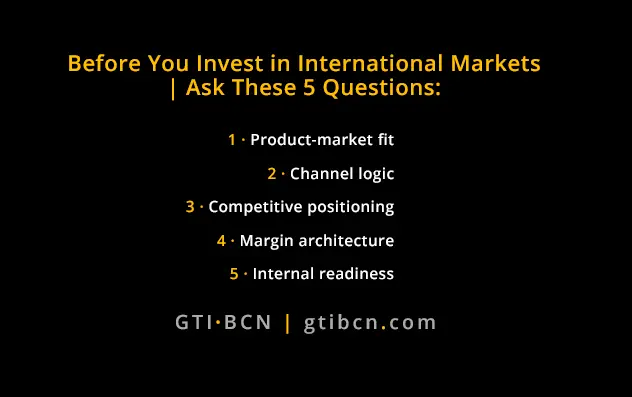
Here is the diagnostic framework I apply before recommending any international investment.
Question 1 — Does Your Product Actually Fit This Market?
Not in general. In this specific market. For this specific buyer profile.
Product-market fit in textile and industrial B2B is not just about whether the product is good. It is about whether it is right for the specific demand structure, price expectations and technical requirements of the target market.
A fabric that sells well to Spanish fast fashion brands may be completely wrong for German technical laminators — even if the technical specifications are similar. The buyer logic, the qualification process, the margin expectations and the relationship dynamics are fundamentally different.
Before entering a market, the right questions are: who actually buys this type of product in this country? At what price point? With what minimum order requirements? With what lead time expectations? And is your product, as it currently exists, genuinely competitive on those parameters?
Export market entry mistakes in textile manufacturing often begin here — with the assumption that a good product is a universally good product.
Question 2 — Do You Understand the Channel Logic?
Who actually buys this type of product in the target country?
Distributor? Agent? Direct brand? Laminator? Converter? Buying office?
Getting this wrong means 12 months of effort reaching the wrong people. I have seen companies spend an entire trade fair season meeting contacts that had no commercial relevance to their actual product — because nobody had mapped the channel structure before committing the budget.
Channel logic varies significantly by market and by product segment. In some markets, distributors control access to end buyers. In others, brands source directly. In technical textile segments, the decision-maker may be a product developer rather than a buyer. In commodity segments, purchasing is centralised and price-driven.
Understanding who makes the buying decision — and how they prefer to be approached — is not a detail. It is the foundation of the commercial architecture.
Question 3 — Can You Answer the Competitive Positioning Question?
Who else is already there, at what price, with what service level?
If you cannot answer this clearly before entering a market, you are not ready to invest in that market.
Competitive positioning in textile B2B is rarely about being cheaper. It is about being different in ways that matter to the specific buyer. Reliability. Lead time. Technical support. Flexibility on minimums. Proximity. Sustainability credentials.
The manufacturers that enter new markets successfully are those that have identified a specific competitive advantage that is relevant to that market — and have built their commercial approach around it. Not a generic pitch. A specific, differentiated value proposition aimed at a specific type of buyer who has a specific reason to switch from their current supplier.
This requires research. It requires honest assessment of where your product and your company genuinely stand relative to the alternatives the buyer already has access to.
Question 4 — Does Your Margin Architecture Support International Distribution?
Can your current margin structure support an international commercial layer?
Many companies discover the answer is no — after committing resources.
International distribution adds cost. Agent or distributor margins. Logistics. Trade fair investment. Sample development. Travel. Administrative overhead. Currency exposure. These costs must be absorbed without making the product uncompetitive at the end buyer level.
This is a calculation that must be done before entering a market — not after the first season of disappointing results. If the margin structure does not support the commercial layer required to reach the end buyer profitably, the market may simply not be viable at current pricing. Or the go-to-market model needs to be redesigned before investing.
This is one of the most common export market entry mistakes textile companies make: assuming that domestic margins will hold internationally without adjustment.
Question 5 — Is Your Company Operationally Ready to Service International Clients?
Reliability is not optional in B2B export.
International clients — particularly in Northern Europe — have high expectations around delivery consistency, communication responsiveness and documentation accuracy. A missed shipment, an incorrect invoice or a slow response to a technical query can end a commercial relationship before it has had time to develop.
Before committing to international market development, the honest question is: does our internal team have the capacity and the processes to service international clients at the standard those clients expect? If the answer is no — or not yet — that is not a reason to abandon international ambition. It is a reason to build internal readiness before investing in market development.
The sequence matters. Internal readiness before commercial investment. Commercial investment before revenue expectations.
Export Market Entry Mistakes Textile Companies — Why It Is Always a Structure Problem
The five questions above are not a checklist— and export market entry mistakes textile manufacturers make are almost always decided before the first sales call. They are a diagnostic framework — a way of identifying, before investing, where the structural gaps are that will determine whether international expansion generates results or simply generates activity.
In 30+ years of direct export market work — textile and industrial B2B, across Europe, Africa, the Americas and Asia-Pacific — the pattern is consistent. The companies that grow sustainably in international markets are not those with the best product. They are those that build the right structure first.
Export market entry mistakes in textile manufacturing are almost always structural — not commercial. They are made before the first sales call, not during it.
If your company is considering international expansion — or trying to understand why current efforts are not producing results — the diagnostic conversation is the right place to start.
No obligation. No pitch. Just clarity.
Avoiding export market entry mistakes textile companies make consistently requires one thing above all: diagnosis before investment.
Related reading: If you are evaluating your international expansion approach more broadly, our complete strategic framework covers market selection, distribution architecture and geopolitical risk in detail.
→ International Expansion Strategy for Textile Companies — Complete Guide
Further reading:
ITC Trade Map (https://www.trademap.org/) ·
Eurostat — EU Textile Trade (https://ec.europa.eu/eurostat) ·
WTO — Global Trade Statistics (https://www.wto.org/english/res_e/statis_e/statis_e.htm)